Navigating Supply Chain Disruption, Sanctions Exposure, and Corporate Risk Across Qatar and the MENA Region
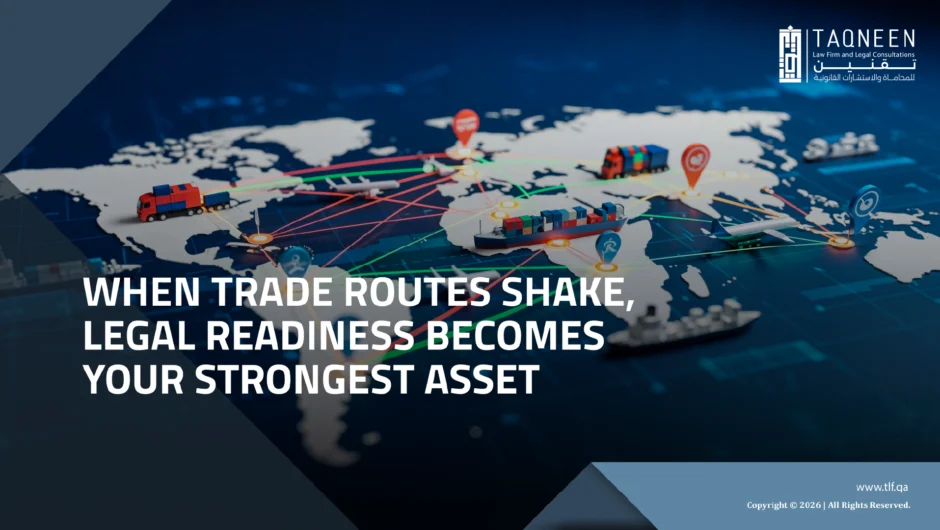
In an increasingly unpredictable regional environment, commercial disruption is no longer a remote possibility, it is an operational reality. Escalating geopolitical tensions across key trade corridors in the Middle East have heightened pressure on supply chains, shipping routes, financial transactions, and corporate decision-making.
For businesses operating in Qatar and across the MENA region, the consequences extend far beyond logistics. Contractual disputes, sanctions exposure, regulatory scrutiny, and crisis response obligations are becoming central boardroom issues.
This week’s edition provides a practical legal and compliance perspective on the challenges organizations face in times of regional instability together with strategic guidance on how businesses can strengthen resilience, reduce exposure, and remain legally prepared.
1 | Supply Chain Disruption & Contractual Exposure
When delivery delays become legal disputes.
 Disruptions across major maritime routes and regional trade corridors continue to affect delivery schedules, freight costs, and contractual performance. In such circumstances, businesses must carefully assess whether legal remedies are available or whether obligations remain enforceable despite operational difficulty.
Under Qatar’s Civil Code (Law No. 22 of 2004), force majeure applies may apply where performance becomes objectively impossible due to an external cause beyond a party’s control. In such cases, affected obligations may be extinguished, and the contract may be rescinded by operation of law.
However, the threshold is high. Increased costs, market volatility, or logistical inconvenience alone do not generally qualify as force majeure.
Where performance remains possible but becomes excessively burdensome, Article 171 empowers the courts to rebalance obligations under the hardship doctrine. This provision is regarded as a matter of public order and cannot be waived contractually may not generally be waived contractually.
For entities operating under the Qatar Financial Centre (QFC) framework, contractual treatment may differ. Under QFC principles under the QFC contract regulations, force majeure commonly operates as a suspension mechanism or defense against breach rather than an automatic basis for rescission subject to the wording of the relevant agreement.
A recent market development illustrates the growing relevance of these issues: in March 2026, QatarEnergy publicly ( Source missing ? ) indicated that it would need to invoke force majeure in relation to certain LNG supply commitments due to circumstances beyond its reasonable control.
Practical lesson: contractual relief depends not on disruption alone, but on legal classification, evidence, and strict adherence to notice obligations.
2 | Maritime Volatility & Shipping Liability
Risk allocation matters most when trade routes become uncertain.
 The Gulf and Red Sea remain among the world’s most strategically significant maritime corridors, handling a substantial share of global energy and commercial shipping activity. Recent instability has amplified operational and legal risks for traders, carriers, and insurers alike.
Businesses relying on these routes are facing increased rerouting costs, longer transit periods, and heightened insurance scrutiny.
In addition, regional reports have highlighted recurring navigation disruptions—including GPS interference and signal anomalies raising concerns around vessel safety and liability allocation.
Under Qatar Maritime Law (Law No. 15 of 1980) and relevant Civil Code provisions, carriers are generally liable for cargo loss or damage unless they can establish that the harm resulted from force majeure, inherent defects in the goods, or fault attributable to the consignor or consignee.
Insurance coverage remains equally complex. Marine, business interruption, and liability policies often contain broad war, hostilities, or political violence exclusions, which may be triggered even without a formal declaration of war.
Practical lesson: businesses should proactively review shipping contracts, charter terms, and insurance wording to ensure risk is properly allocated before disruption occurs.
3 | Sanctions Pressure & Cross-Border Compliance
Compliance failures often begin where due diligence ends.
As international sanctions frameworks continue to expand, companies operating across borders must contend with overlapping legal obligations and heightened regulatory expectations.
Recent enforcement actions by US authorities have targeted networks facilitating restricted trade activities, with particular attention on entities operating through intermediary jurisdictions. This has increased exposure for businesses involved in energy, logistics, commodities, and financial services.
For Qatari businesses, sanctions and transaction monitoring obligations are reinforced through a robust domestic framework, including:
- Law No. 20 of 2019 on Combating Money Laundering and Terrorism Financing
- Law No. 27 of 2019 on Combating Terrorism
- Related implementing regulations governing targeted financial sanctions and reporting obligations
In 2025, the Qatar Central Bank strengthened its Customer Due Diligence framework, introducing enhanced verification standards for Ultimate Beneficial Owners, ongoing transaction monitoring, and risk-based customer categorization.
Simultaneously, the Qatar Financial Information Unit launched its 2025–2030 strategy, focusing on intelligence-led compliance and earlier identification of suspicious activity.
Because certain sanctions regimes may impose liability on a strict basis, businesses can face enforcement risks even in the absence of intentional wrongdoing.
Practical lesson: effective sanctions compliance requires more than screening names—it demands visibility into ownership structures, jurisdictional links, and transaction purpose.
4 | Crisis Governance & Regulatory Resilience
Resilience is no longer optional; it is increasingly regulated.
Across sectors, regulators are shifting expectations from reactive incident response toward integrated resilience planning.
In Qatar, this evolution is reflected in several developments:
- In February 2025, Qatar’s National Cyber Security Agency (NCSA) introduced the National Incident Management Framework to enhance national cyber resilience. The framework sets out a structured seven-pillar model spanning detection, response, and recovery, aimed at coordinating efforts among stakeholders, law enforcement, and critical sectors to ensure the rapid restoration of services during major cyber incidents.
- The QFC Regulatory Authority implemented updates to its CTRL Rules, effective 1 October 2025.
- The Qatar Central Bank issued a Data Handling and Protection Regulation addressing governance, continuity, and disaster recovery standards.
These developments reflect a broader regional trend: resilience is becoming a measurable compliance expectation rather than a discretionary operational objective.
Organizations are increasingly expected to integrate legal, operational, cybersecurity, and governance functions into a unified resilience framework.
Practical lesson: crisis readiness should be embedded into enterprise governance not treated as a standalone contingency exercise.
Why This Matters Now?
Regional instability may be temporary. Legal consequences rarely are.
Businesses that proactively reassess contracts, strengthen compliance controls, and embed resilience into governance structures are better positioned to preserve continuity and protect value.
Those that delay may find themselves navigating disputes, enforcement actions, or operational failures under significantly greater pressure.
How Taqneen Law Firm Supports Businesses in Uncertain Times
Strategic legal counsel for high-risk operating environments.
At Taqneen Law Firm, we provide practical, business-focused legal solutions for organizations operating in volatile and highly regulated markets.
Our advisory services include:
- Contract Audits & Force Majeure Strategy
- Sanctions & Trade Compliance Advisory
- Maritime Claims & Carrier Liability Representation
- Crisis Governance & Regulatory Preparedness
- QFC & Free Zone Structuring
- Cross-Border Dispute Resolution & Litigation
- Government & Regulatory Liaison Regulatory Engagement & Administrative Support
In uncertain markets, preparedness is not merely protection, it is strategic advantage.
As regional dynamics continue to evolve, legal readiness will distinguish businesses that adapt successfully from those that react too late.
Taqneen Law Firm remains committed to helping organizations navigate complexity with clarity, confidence, and resilience.
Disclaimer: This publication is provided for general informational purposes only and does not constitute legal advice.