The information and content provided in this publication are for general informational purposes only and do not constitute legal advice.
While every effort has been made to ensure the accuracy and relevance of the information as of the date of publication, laws and regulations are subject to change, and the application of legal principles may vary based on specific facts and circumstances.
Readers are advised to seek professional legal counsel before acting upon any of the information contained herein. Taqneen law firm accepts no responsibility or liability for any loss or damage that may arise from reliance on the information contained in this article.
For further assistance or tailored legal advice, please contact Taqneen law firm directly.
INTRODUCTION
For many years, when people spoke about Qatar and business in the same sentence, the conversation was usually about hydrocarbons, major infrastructure projects, and billion-dollar government contracts. The word “startup” rarely featured prominently. Entrepreneurial ecosystems were often associated with more established startup hubs, and the spotlight rarely fell on Qatar when discussions turned to entrepreneurship and venture-backed innovation. Instead, the country was better known for state-led development, major infrastructure projects, and established industries.
That perception is no longer accurate.
Over the past three years, Qatar has undergone a deliberate, well-capitalized transformation into one of the most promising startup ecosystems in the MENA region. Entrepreneurship has become a national priority rather than a side project. Venture capital activity has accelerated dramatically, a unicorn has emerged from Doha, the country’s sovereign wealth fund is investing billions into leading global venture capital firms, and regulatory reforms now permit foreign founders to retain 100% ownership across most sectors.
This transformation has not occurred by chance. It is the result of a coordinated national strategy aimed at economic diversification, innovation, and private-sector growth. What began as an ambitious policy objective has evolved into a thriving ecosystem supported by government institutions, free zones, accelerators, investors, and an increasingly sophisticated legal framework.
At Taqneen Law Firm, we have had a front-row seat to this evolution. We have advised founders on company incorporation, free zone incentives, intellectual property protection, fundraising transactions, and shareholder arrangements. From our perspective, this is not a short-term trend or a moment of market enthusiasm. It is a structural shift in Qatar’s economic landscape.
This article provides a lawyer’s assessment of Qatar’s startup ecosystem: the data behind its growth, the institutions driving its development, the success stories that have captured regional attention, and the key legal considerations founders and investors should understand when building and scaling businesses in Qatar.
THE NUMBERS THAT DEMAND ATTENTION
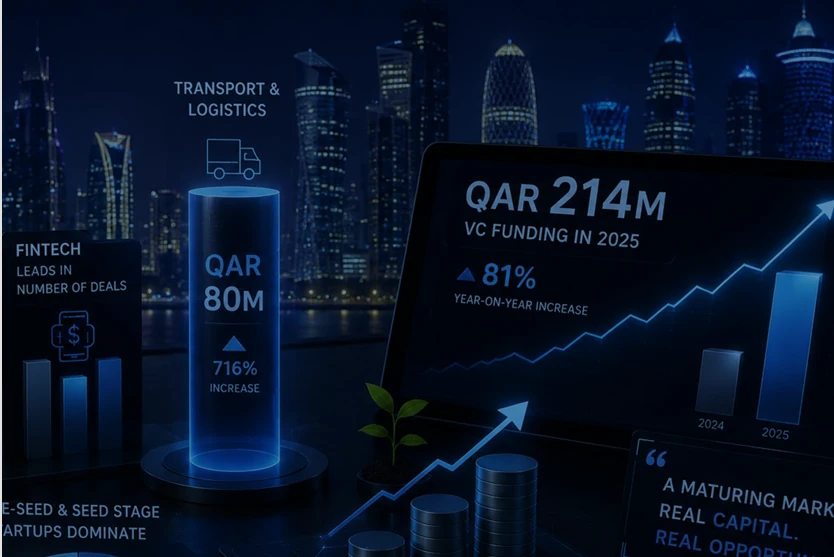
After a slight slowdown in 2023, Qatar’s venture capital scene rebounded significantly in 2025. VC funding reached a record QAR 214 million (approximately USD 58.5 million), representing an 81% year-on-year increase.
Fintech remains the undisputed leader in terms of the number of deals. However, the transport and logistics sector recorded the most significant capital concentration, raising QAR 80 million, a 716% increase from the prior period, largely attributable to one substantial transaction.
Notably, early-stage startups at the pre-seed and seed stages continue to dominate the landscape, accounting for 93% of all deals. However, the average ticket size is rising. This signals a market where risk capital is not merely present but actively maturing. For a founder considering regional headquarters, these figures indicate a functioning venture economy with room for new entrants.

INSTITUTIONAL ANCHORS
WHERE STARTUPS OPERATE AND SCALE
A credible startup ecosystem requires more than capital. It requires physical and programmatic homes where founders can incorporate, test, scale, and connect. Qatar has developed several institutional anchors that collectively serve this function.
Qatar Science and Technology Park (QSTP) operates as the primary hub for deep technology ventures, including artificial intelligence, robotics, biotechnology, and clean technology. Located within Qatar Foundation’s Education City, QSTP currently supports over 180 ecosystem partners and maintains a pipeline of more than 820 companies. Its recently launched USD 30 million Tech Venture Fund is directed specifically at early-stage deep tech startups with measurable social or climate impact. A concrete example of a QSTP-incubated company is a biotechnology startup founded by an all-women team that deploys microalgae to capture atmospheric CO2. The startup has received national entrepreneurship recognition and regional media coverage for its innovative climate-focused solution.
The TASMU Accelerator, backed by the Ministry of Communications and Information Technology, functions as a market-entry bridge rather than a pure incubator. Its 75 alumni companies have achieved a combined portfolio value exceeding QAR 4 billion, with aggregate sales of QAR 670 million. The third cohort alone generated over QAR 330 million in local revenue. What distinguishes TASMU is its corporate partnership model. Leading telecommunications, financial services, and professional consulting organizations serve as partners that do not merely provide funding but actively open their customer bases to participating startups. A foreign founder with a digital solution ready for deployment can use TASMU to secure pilot contracts with some of Qatar’s largest enterprises, thereby generating revenue and validation simultaneously.
The Qatar Investment Authority’s USD 1 billion Fund of Funds programme represents a sophisticated mechanism for importing global venture expertise. Rather than investing directly in startups, QIA allocates capital to established international venture capital firms on the condition that they establish regional headquarters in Doha. The practical effect for a foreign founder is that world-class mentorship, governance standards, and co-investment networks are now
A credible startup ecosystem requires more than capital. It requires physical and programmatic homes where founders can incorporate, test, scale, and connect. Qatar has developed several institutional anchors that collectively serve this function.
The Qatar FinTech Hub (QFTH) has emerged as a cornerstone of Qatar’s financial innovation landscape, offering entrepreneurs access to a regulatory sandbox administered by the Qatar Central Bank, development grants of up to QAR 1.5 million per company, and direct investment of up to QAR 730,000 through Qatar Development Bank. The impact of QFTH can be seen in the success of fintech startups that have leveraged the sandbox environment to test innovative financial solutions with real customers under the supervised relaxation of certain regulatory requirements. By enabling companies to validate their technologies before pursuing full regulatory licensing, the sandbox significantly reduces the time, cost, and uncertainty typically associated with entering highly regulated financial markets. For foreign fintech founders in particular, this framework addresses one of the industry’s greatest challenges: navigating compliance requirements while simultaneously developing and commercializing new products.
Qatar’s startup ecosystem extends far beyond business incorporation and licensing procedures. A network of institutions, including the Qatar Development Bank (QDB), the Digital Incubation Center (DIC), Qatar Business Incubation Center (QBIC), and Qatar Science & Technology Park (QSTP), provides entrepreneurs with access to funding opportunities, incubation programs, mentorship, investor networks, and market-entry support. In 2025 alone, the Digital Incubation Center incubated dozens of emerging technology startups through its Idea Camp programs while Qatar Development Bank continued expanding founder-support initiatives designed to attract both local and international entrepreneurs. Collectively, these organizations have helped build a dynamic and increasingly sophisticated entrepreneurial ecosystem in which startups can do more than simply establish a legal presence; they can access the expertise, capital, and strategic support necessary to grow and compete on a regional and global scale.
Another factor enhancing Qatar’s appeal as a startup destination is the breadth and flexibility of incorporation and licensing options available to entrepreneurs. Businesses may establish themselves on the mainland, where foreign investors can benefit from 100% ownership in most sectors, or choose from several specialized jurisdictions tailored to different industries and growth ambitions. These include the Qatar Financial Centre (QFC), which operates under an independent legal and regulatory framework supporting a wide range of commercial and professional activities; the Qatar Free Zones Authority (QFZA), which offers incentives for companies operating in strategic sectors such as logistics, technology, and advanced manufacturing, Qatar Science & Technology Park (QSTP), a leading hub for technology, research, and innovation-driven ventures; and Media City Qatar, which is specifically designed to support businesses in media, digital content, communications, and the creative industries. Together, these platforms provide founders with exceptional flexibility when determining how to structure their operations, attract investment, and scale their businesses, positioning Qatar as one of the region’s most versatile and entrepreneur-friendly business environments.
HOMEGROWN SUCCESS STORIES
Data and infrastructure are necessary but not sufficient. A credible ecosystem requires demonstrated outcomes.
Snoonu is the most prominent Qatari startup success story to date. This Qatari super-app achieved unicorn status, exceeding a QAR 1 billion valuation, and secured a strategic partnership with Saudi Arabia’s Jahez Group. This partnership confirms that Qatari-origin companies can compete and win on a regional stage.
A notable example is a biotechnology startup founded by an all-women team that uses microalgae to capture CO2 from the atmosphere at ten times the rate of mature trees, converting it into oxygen and valuable biomass. Incorporated in November 2024, the company has already won a national entrepreneurship award and received regional media coverage. It exemplifies the type of purpose-driven, high-impact innovation that Qatar’s ecosystem is designed to nurture.
Additional validation comes from a technology startup that won the Best App in MENA award for 2025, fintech ventures that were admitted to the Qatar Central Bank’s regulatory sandbox, and the top three winners of the third cohort of a leading government-backed accelerator programme, each of which received QAR 200,000 in programme funding. These successes are not isolated anomalies. Rather, they demonstrate the tangible outcomes that Qatar’s entrepreneurial ecosystem is increasingly capable of producing and replicating across multiple sectors.
INTERNATIONAL STARTUPS THAT HAVE GROWN FROM QATAR
Several foreign startups have chosen Qatar as their launchpad for regional growth, highlighting the country’s increasing attractiveness as a destination for international entrepreneurs. One European artificial intelligence company secured a $7 million Series B extension led by the Qatar Development Bank in early 2026, marking the bank’s first direct investment in an Italian company. The startup subsequently selected Doha as its operational hub for expansion across Qatar and the wider GCC region, leveraging advanced Arabic-language capabilities tailored to regional markets.
Similarly, an East Asian AI-driven energy optimization company relocated its global headquarters and command center to Doha, using Qatar as a base from which to scale smart city solutions throughout the Gulf region. Another cybersecurity venture, established through a university-led research commercialization programme and built on technology licensed from a leading national research institute, has grown to more than 65 employees across 24 countries and achieved a valuation exceeding $100 million while serving major international clients from its Qatari base.

In the agritech sector, a Doha-founded company secured $275,000 in funding in 2026 to accelerate the deployment of AI-powered hydroponic farming solutions. The company has also been approved for inclusion in the Qatar Development Bank Exporter Directory, strengthening its ability to serve both the domestic market and customers across the GCC.
Collectively, these examples demonstrate that foreign startups are not merely passing through Qatar. Rather, they are establishing substantial operations, securing local investment, commercializing innovative technologies, and using the country as a strategic platform for expansion throughout the Gulf region and beyond.
WHY FOREIGN FOUNDERS SHOULD CHOOSE QATAR FOR ESTABLISHMENT
For a founder based outside Qatar, whether in Europe, North America, or elsewhere in the Middle East, the question is not whether the region offers opportunity. It is why Qatar, specifically, merits attention over more established hubs in the region. The answer rests on four distinct advantages as follows:
A defining feature of Qatar’s startup landscape is its combination of capital availability and government-backed investment alignment. Qatar’s sovereign wealth ecosystem and development institutions actively co-invest alongside private capital on transparent and commercially structured terms. Through programmes such as the Qatar Investment Authority’s Fund of Funds initiative, leading global venture capital firms are encouraged to establish a presence in Doha, strengthening the flow of international capital and significantly improving local startups’ access to follow-on funding without imposing intrusive governance constraints.
Equally significant is the clarity and evolution of Qatar’s legal framework on foreign ownership. With the introduction of Law No. 1 of 2019, the long-standing requirement for a local majority shareholder in most sectors was effectively removed. Today, foreign founders can incorporate and fully own mainland entities, retaining complete control over intellectual property, governance, equity structuring, and exit decisions. This stands in contrast to jurisdictions where local sponsorship arrangements or complex nominee structures remain necessary in certain industries. The result is a more direct, predictable, and legally coherent environment for company formation and operation.
Regulatory flexibility further strengthens this positioning, particularly in emerging sectors such as fintech. The Qatar Central Bank’s regulatory sandbox provides startups with the ability to test and refine innovative financial products in a controlled environment without immediately obtaining a full financial services license. The pathway from experimentation to authorization is clearly defined, and the framework has already been used by a number of internationally founded ventures seeking entry into the region. For fintech founders, this creates a lower-friction route to market compared to many competing jurisdictions
Beyond regulation and capital, Qatar also offers a practical operating environment that is often underestimated in legal analysis. The country consistently ranks highly in expatriate quality of life indicators, supported by advanced healthcare systems, modern infrastructure, and strong educational institutions. For founders and their teams, the process of establishing a physical presence is straightforward, whether within specialized zones or serviced office environments. Visa procedures for investors, founders, and key personnel are generally predictable, adding operational stability that is often critical in the early stages of a startup’s lifecycle.

THE LEGAL FRAMEWORK: THREE ENTRY ROUTES AND A CRITICAL LEGISLATIVE SHIFT
For a lawyer advising startup clients, the most consequential development in recent years is Law No. 1 of 2019, the Foreign Investment Law. Under this legislation, a foreign founder may now own 100% of a company in most economic sectors. The previous requirement of a 51% Qatari partner has been eliminated across many commercial activities. Exceptions remain for certain strategic sectors such as banking and insurance, where foreign ownership remains capped at 49 % unless a specific Cabinet exemption is obtained. For the vast majority of technology, service, and trade startups, however, full foreign ownership is now the default legal position.
Before proceeding further, it is worth addressing three persistent misconceptions that foreign founders often carry. First, Qatar is not exclusively for large enterprises or government contractors. The data above confirms that early-stage startups account for 93% of all VC deals. Second, 100% foreign ownership is no longer exceptional; it is the default under Law No. 1 of 2019 for most commercial activities. While fluency in Arabic is not a prerequisite for establishing and operating a business in Qatar, the practical requirements vary depending on the jurisdiction. In Qatar’s free zones and many commercial settings, English is the primary language used for business operations, contracts, and regulatory interactions. However, mainland Qatar involves a greater degree of Arabic-language documentation and government-facing procedures. As a result, foreign founders are well advised to engage a local law firm to ensure that all incorporation, licensing, compliance, and contractual matters are properly managed and aligned with local legal requirements.
In practice, founders have three primary legal structures from which to choose, each with distinct advantages and limitations.
A Mainland company registered with the Ministry of Commerce and Industry is generally the most appropriate for startups seeking direct access to the local Qatari market, including the ability to bid for government contracts. Under Law No. 1 of 2019, Mainland registration can now be effected with 100% foreign ownership for eligible activities.
The Qatar Financial Centre (QFC) is the preferred route for startups operating in financial services, consulting, or professional services. The QFC operates under an English common law framework, provides 100% foreign ownership, and offers a fully digitized, expedited registration process. For founders familiar with common law jurisdictions, the QFC reduces legal friction considerably.
The Qatar Free Zones (QFZ) are optimal for logistics, manufacturing, and technology startups with an export-oriented business model. The QFZ offers 100% foreign ownership and, most significantly, a tax holiday of up to twenty years with zero corporate tax. The trade-off is that free zone entities face restrictions on selling directly into the local Qatari market. This structure suits founders whose primary revenue originates outside Qatar.
COMMON LEGAL PITFALLS AND STRATEGIES FOR AVOIDING THEM
Over several years of advising startup clients, we have observed recurring errors that materially affect founders’ control, cost, and continuity. These are not theoretical concerns; they are actual disputes and regulatory actions we have helped clients resolve.
The first and most frequent mistake is entering into a local sponsorship or partnership arrangement without a comprehensive Shareholder Agreement. Even where the law permits 100% foreign ownership, some founders nevertheless accept minority positions without contractual protections. In the absence of a properly drafted Shareholder Agreement, the majority partner may unilaterally control bank accounts, visa sponsorship, and corporate approvals. A well-structured agreement reserves veto rights over major decisions, preserves management control, and defines a clear, fair exit mechanism.
The second common error is operating without a physical office address that complies with the entity’s licence requirements. This omission regularly results in visa rejections, banking restrictions, and, in some cases, administrative suspension of the commercial registration. Compliant office solutions are available through QSTP, the free zones, and licensed serviced office providers. The cost of non-compliance far exceeds the cost of securing a proper address.
Third, founders frequently assume that intellectual property registered within a free zone enjoys automatic protection in the Mainland market. That assumption is incorrect. Trademarks and patents registered through free zone authorities must also be registered separately with the Ministry of Commerce and Industry for enforcement onshore. Founders should prioritize this step before launching any customer-facing operations.
Fourth, delayed renewal of commercial registration is a surprisingly common source of operational disruption. Expired registrations result in blocked services, frozen bank accounts, and an inability to sponsor or renew employee visas. These consequences are entirely avoidable through systematic calendar management, which we provide as a matter of course for our corporate clients.
THE CATALYTIC EVENT: WEB SUMMIT QATAR
No assessment of Qatar’s startup ecosystem would be complete without rereferring to Web Summit Qatar. The 2026 edition brought together 388 early-stage startups from 59 countries. Since the inaugural Web Summit Qatar in 2025, 69 participating startups have raised a combined USD 205 million in follow-on funding, with artificial intelligence and machine learning ventures accounting for USD 125 million of that total. For a founder considering market entry, Web Summit Qatar functions as both a barometer of ecosystem health and a practical venue for meeting co-investors, corporate partners, and legal advisers.
CONCLUSION
Qatar’s startup ecosystem has moved beyond theoretical promise into measurable performance. The funding data demonstrates liquidity. The institutional infrastructure provides operational homes. The success stories confirm that local startups can achieve regional and global relevance. And the legal framework, particularly Law No. 1 of 2019, has removed the historic impediment of mandatory local majority ownership. At Taqneen Law Firm, we advise founders on entity selection, incorporation, intellectual property registration, shareholder agreements, and ongoing compliance. For a confidential initial assessment of your startup’s proposed entry into Qatar, including optimal entity selection, ownership eligibility, and expected incorporation timelines, we welcome you to contact our team.
WWW.TLF.QA